Advances in Agentic AI: Back to the Future
Abstract: In light of the recent convergence between Agentic AI and our field of Algorithmization, this paper seeks to restore conceptual clarity and provide a structured analytical framework for an increasingly fragmented discourse. First, (a) it examines the contemporary landscape and proposes precise definitions for the key notions involved, ranging from intelligence to Agentic AI. Second, (b) it reviews our prior body of work to contextualize the evolution of methodologies and technological advances developed over the past decade, highlighting their interdependencies and cumulative trajectory. Third, (c) by distinguishing Machine and Learning efforts within the field of Machine Learning (d) it introduces the first Machine in Machine Learning (M1) as the underlying platform enabling today's LLM-based Agentic AI, conceptualized as an extension of B2C information-retrieval user experiences now being repurposed for B2B transformation. Building on this distinction, (e) the white paper develops the notion of the second Machine in Machine Learning (M2) as the architectural prerequisite for holistic, production-grade B2B transformation, characterizing it as Strategies-based Agentic AI and grounding its definition in the structural barriers-to-entry that such systems must overcome to be operationally viable. Further, (f) it offers conceptual and technical insight into what appears to be the first fully realized implementation of an M2. Finally, drawing on the demonstrated accuracy of the two previous decades of professional and academic experience in developing the foundational architectures of Algorithmization, (g) it outlines a forward-looking research and transformation agenda for the coming two decades.
Paper Prompts
Sign up for free to create and run prompts on this paper using GPT-5.
Top Community Prompts
Explain it Like I'm 14
A simple guide to “Advances in Agentic AI: Back to the Future”
What this paper is about (the big idea)
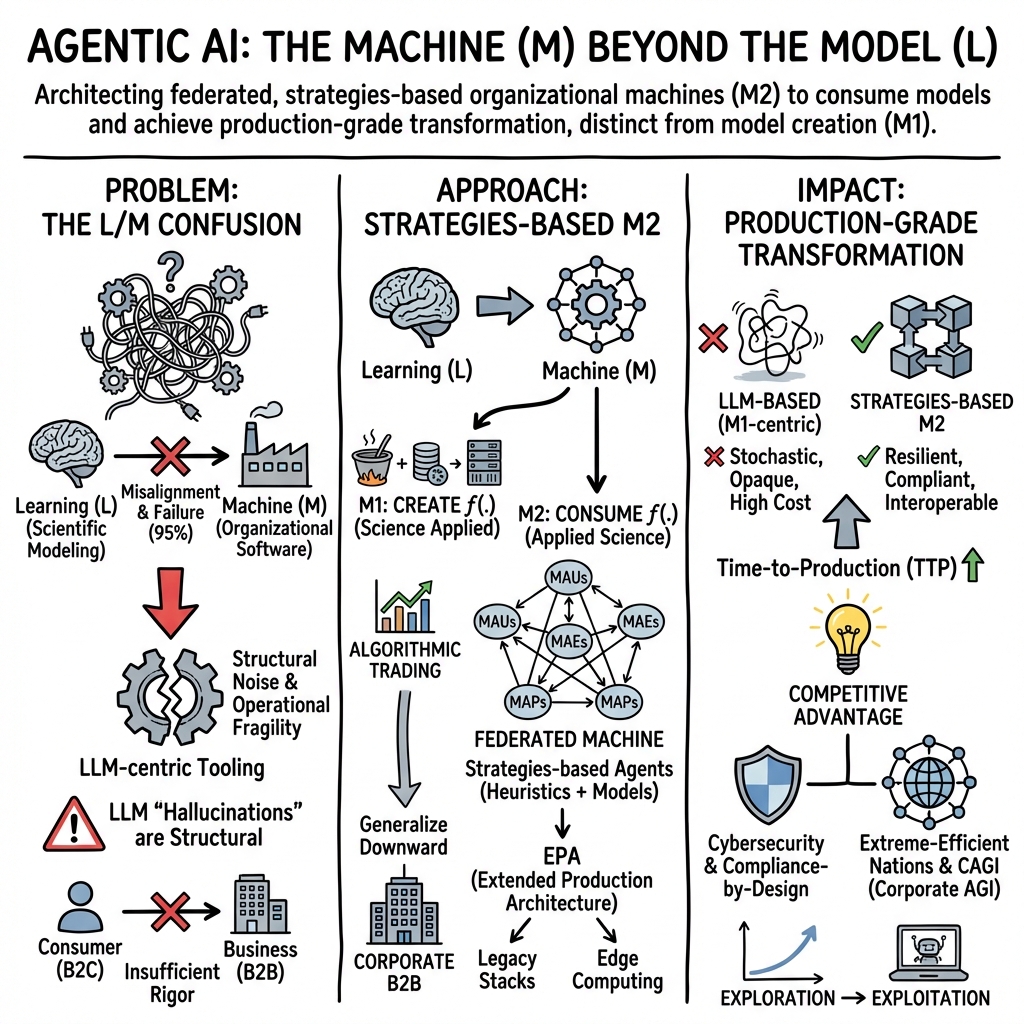
This paper explains a clearer way to think about Agentic AI—AI systems that can plan, decide, and act. The authors say most people focus on the “Learning” part of AI (like training big models such as LLMs), but the real game-changer is the “Machine” part: the full system that lets AI safely and reliably run inside companies, across departments, and even across whole industries or countries.
Their main message: long‑lasting advantage doesn’t come from the model itself, but from the architecture around it—the way you combine models, rules, data, security, and workflows so the whole organization can use AI well.
The key questions the paper asks
- What exactly is Agentic AI, and how should we define it?
- Why do many AI projects fail when companies try to use them in real life?
- What’s the difference between the “Learning” (L) and the “Machine” (M) in Machine Learning?
- What kinds of “Machines” do we need to make AI useful at scale in business?
- Can we build a full company-wide AI system that’s reliable enough for daily operations?
How the authors approach the problem (in everyday language)
Think of AI like cooking:
- The “Learning” (L) is the recipe—the math and statistics that produce a model.
- The “Machine” (M) is the kitchen, the tools, the staff, the hygiene rules, the supply chain, and the restaurant schedule that turns recipes into thousands of safe, on‑time meals every day.
The authors say there are two different “Machines” inside Machine Learning:
M1: The first Machine
- What it is: The heavy engineering that creates big models (like LLMs). It needs lots of chips, data pipelines, and experimentation.
- Analogy: Building an advanced kitchen to make a special sauce (the model).
- Limits: Great for making the sauce, but it doesn’t run a full restaurant.
M2: The second Machine
- What it is: A larger architecture that runs the whole “restaurant chain.” It connects data, models, rules, compliance, security, and actions across an entire company. It can even spin up M1s when needed.
- Analogy: The full restaurant system—menus, scheduling, suppliers, kitchen tools, food safety, payment, and delivery—all working together.
- Why it matters: Companies need M2 to use AI safely and effectively in real life.
The paper also compares two ways to build M2:
- LLM-based M2: Build the system around LLMs that generate code and actions. Problem: LLMs make confident guesses by design (“hallucinations”), are hard to fully control, and can be unpredictable—risky for critical operations.
- Strategies-based M2: Start from the toughest real-world environment (algorithmic trading) and design top‑down rules, strategies, and workflows that are explainable and controllable. Then generalize those ideas to the rest of the business.
What they did:
- Defined terms clearly to avoid hype and confusion.
- Reviewed a decade of their past work (products, departments, companies, sectors, and national strategy).
- Proposed the “Machine Theory of Agentic AI” (M1 vs. M2).
- Described what seems to be their first full M2 implementation.
- Offered a roadmap for the next 10–20 years.
Main findings (what they learned and why it matters)
- The real advantage is the Machine, not the model.
- Models (the “L”) are becoming commodities—anyone can access similar math. The winning edge is how you deploy and orchestrate models at scale (the “M”).
- LLMs are powerful but have built‑in limits for production.
- So-called “hallucinations” aren’t accidents; they’re part of how LLMs work (they estimate likely text). That’s dangerous if you build core operations on them without strict controls.
- Companies fail when they treat AI as a gadget, not an architecture.
- Many organizations aren’t ready: their processes, procurement, providers, and talent management aren’t set up for AI-as-infrastructure.
- M2 is the missing layer for real transformation.
- M2 combines models, rules, data flows, security, and governance so AI can run across departments. It’s the “AI operating system” for a business.
- Strategies-based Agentic AI is more reliable for serious use.
- By starting from the hardest domain (algorithmic trading), you design for speed, safety, and accountability. Those capabilities then scale to other areas like cybersecurity, finance, operations, and compliance.
- They claim to have built a working M2.
- They describe a decade-long journey: starting with trading (their M1), then generalizing into a full M2, applying it in multiple industries, and packaging it as customizable software that can spread across departments and companies.
- Bigger picture: focus on AI consumption, not just creation.
- Nations and firms that get really good at using AI (M2) may gain more value than those focused only on building models (M1). This affects economics, defense, and national strategy.
Why this matters (impact and implications)
For companies
- Don’t expect magic from models alone. Build the M2 layer—the architecture that makes AI safe, explainable, and useful across the whole organization.
- Prioritize Strategies-based Agentic AI for mission-critical tasks.
- Organize transformation in three layers:
- The M2 platform,
- Keep the basic “right‑to‑play” (operations that must work),
- Grow the “right‑to‑win” (what makes you uniquely competitive).
For sectors and investors
- New portfolio ideas: manage risk and performance by strategy “dimensions,” not just by instruments. This gives clearer control and accountability.
- Augmented roles: people guide and supervise; machines handle heavy, repetitive, and fast tasks.
For cybersecurity and defense
- Agentic AI can coordinate actions across systems, markets, and social media—both for attacks and defense.
- The paper warns of “boardroom takeovers” via coordinated manipulation and explains how to design legal, auditable defenses.
For countries
- Extreme‑efficient nations will master AI consumption (M2)—turning AI into measurable productivity across industries.
- The authors propose “Corporate AGI” (CAGI): a practical, many‑parts intelligence across companies that coordinate, rather than chasing human‑like AGI.
In short (a simple wrap‑up)
- Building bigger models isn’t enough. The real breakthrough is building the Machine around them.
- M1 makes models. M2 runs the business with them.
- LLMs are helpful but risky if used as the core of critical operations without the right architecture.
- Start from the hardest cases, design top‑down, and scale across the organization.
- The winners—companies and nations—will be those who master M2: the architecture that turns AI into reliable, everyday performance.
Knowledge Gaps
Knowledge gaps, limitations, and open questions
Below is a single, concrete list of what the paper leaves missing, uncertain, or unexplored, framed so future researchers can act on each item.
- Formal specification of M2: precise definitions and machine-level properties (e.g., composability, determinism, fault tolerance, consistency, safety invariants) are not given; a rigorous architectural spec, interfaces, and protocol-level guarantees are needed.
- Empirical validation of the “first fully realized M2”: independent audits, reproducible case studies, performance reports, and failure analyses are absent; third-party replication and evaluation protocols should be established.
- Quantitative benchmarks for Agentic AI systems: no standardized metrics or test harnesses exist to compare M2 implementations (accuracy, latency, determinism, robustness, cost-to-serve, energy use, security posture); a common evaluation suite is needed.
- Evidence that LLM “hallucinations” are structural: the claim requires formal proofs or statistical characterization across tasks, model families, training regimes, and retrieval-augmented setups, plus quantified risk under production constraints.
- Conditions under which LLM-based M2 is viable: criteria and engineering patterns to deliver production-grade determinism, auditability, and safety with LLMs (e.g., constrained generation, formal guardrails, retrieval/validation loops) are not specified.
- Concrete mechanisms for integrating heuristics and models in M2: missing are design patterns for rule–model orchestration, conflict resolution, uncertainty propagation, and runtime governance across heterogeneous components.
- Observability and assurance for Strategies-based Agents: no detailed methods for logging, provenance, explainability, accountability trails, or real-time risk scoring at agent/action level; a comprehensive observability framework is needed.
- Safety, compliance, and legal governance: actionable policies, controls, and liability models for cross-department and cross-company orchestration (especially in regulated contexts) are underspecified; compliance-by-design blueprints should be developed.
- Cybersecurity of M2: the attack surface, threat models, adversarial scenarios (including agent-to-agent exploitation), red-teaming methodologies, and formal security claims are not detailed; a security reference architecture is required.
- Data governance and privacy: protocols for federated data sharing (identity, permissions, trust, policy enforcement, lineage), privacy-preserving computation (DP, MPC, federated learning), and cross-border data compliance remain undefined.
- Interoperability with legacy enterprise stacks: migration paths, integration adapters, data/semantic mapping, and coexistence strategies with current ERP/CRM/BI systems are not elaborated; reference integrations and patterns are needed.
- Scalability and multitenancy of Custom SaaS M2: resource isolation, noisy-neighbor control, per-tenant SLAs, update strategies, and versioning across federated deployments are not covered; a multitenant operations playbook is missing.
- Cost, energy, and hardware modeling: TCO models, energy efficiency analyses, hardware sizing, scheduling, and carbon impacts for sustained M2 operations are not quantified; economic and environmental performance models are needed.
- Robustness to distribution shift: methods for continuous validation, drift detection, rollback, safe exploration/exploitation, and adaptive policy updates across dynamic business environments are not specified.
- Formalization of “intelligence” and Agentic AI taxonomy: the paper’s definitions require operational metrics and tests to distinguish agentic capability from statistical modeling, including task classes and measurable agency dimensions.
- Generalization beyond Algorithmic Trading: the claim that M2 generalizes “top-down” from the most complex domain to others needs empirical studies across multiple non-financial sectors, with documented constraints and adaptations.
- The Cube and TRL assignments: criteria and measurement instruments for Technology Readiness Levels and universality claims are not provided; standardized TRL rubrics and sector-specific validations are needed.
- Strategy vs data science services scaling limits: quantitative models of human-service bottlenecks, talent requirements, productivity curves, and mitigation strategies (templates, automation, training pipelines) are not offered.
- Procurement and vendor alignment: actionable standards for RFPs, evaluation frameworks, and contractual governance tailored to M2 (including audit rights, safety SLAs, and change management) remain unspecified.
- Economic impact and ROI: the promised “rights-to-win” improvements, GDP/productivity gains, and portfolio-level synergies lack quantified evidence; controlled studies and macro–micro simulation models are needed.
- Corporate AGI (CAGI) framework: a formal architecture, capability metrics, simulation environments, regulatory implications, and inter-company coordination models for CAGI are not articulated.
- Blockchain vs Data MAPs comparison: no rigorous, scenario-based empirical comparison (latency, throughput, consistency, auditability, cost, governance) is provided; benchmark studies are needed.
- Human-in-the-loop design: concrete mechanisms for supervision, escalation, override, and accountability in Strategies-based Agentic AI are missing; role definitions and decision rights need codification.
- Failure modes and incident response: taxonomies of agentic failures (technical, organizational, regulatory), incident playbooks, and resilience testing (chaos engineering for agents) are absent.
- Talent frameworks: competency models, training curricula, certification paths, and organizational design for M2-era roles (architects, orchestration engineers, assurance leads) are not developed.
- Cross-organizational federations: standards for multi-entity coordination (identity, trust, incentives, conflict resolution, shared governance) in sector/national deployments are not defined.
- Defense and “boardroom capture” scenario: detection, attribution, ethics, legal boundaries, and validated defensive countermeasures require simulation studies, policy guidance, and regulator-tested protocols.
- Reproducibility pathway for proprietary systems: an explicit plan for scientific reproducibility (minimal publishable artifacts, synthetic benchmarks, sandbox environments, interface specs) is missing.
- Adoption roadmap: phased guidance for organizations transitioning from LLM-centric initiatives to Strategies-based M2 (readiness assessments, pilot templates, risk gates, KPIs) is not provided.
Practical Applications
Practical Applications Derived from “Advances in Agentic AI: Back to the Future”
The paper’s core contribution is a shift from model-centric “Learning” (L) to architecture-centric “Machine” (M), distinguishing M1 (model-creation infrastructures) from M2 (enterprise-scale, federated, Strategies-based Agentic AI for AI consumption). Below, applications are grouped by deployment horizon and annotated with likely sectors, emerging tools/workflows, and key dependencies.
Immediate Applications
These can be piloted or deployed now with existing capabilities, especially by organizations willing to adopt Strategies-based Agentic AI principles and hybridize models with heuristics, governance, and orchestration.
- M2-readiness assessment and procurement reform [Enterprise, Policy, Consulting]
- What: Redesign AI procurement to distinguish L/M1 (model creation) from M2 (AI consumption/agentic orchestration), with evaluation criteria for determinism, auditability, compliance, and cross-department orchestration.
- Tools/workflows: TRL-style scoring using “The Cube”; vendor questionnaires on determinism/traceability; gating policies for LLM use in production.
- Dependencies: Executive sponsorship; legal/compliance involvement; access to departmental process maps.
- LLM risk containment and role definition [Software, Cybersecurity, Healthcare, Finance, Education]
- What: Constrain LLMs to non-critical, B2C-like or analyst-support contexts; enforce guardrails that prevent structural “errors by design” from entering production-grade flows.
- Tools/workflows: Human-in-the-loop approval layers; prompt-policy catalogs; model-switching/routing with fallback to deterministic heuristics; red-team tests of “vibe-coded” apps.
- Dependencies: Model governance board; monitoring for non-determinism; incident playbooks.
- Launch a department-level M2 pilot with Strategies-based agents [Enterprise IT, Operations, CFO, Communications]
- What: Build a minimal-but-complete “on-platform” departmental workflow (e.g., CFO–Comms–Cyber) that coordinates data flows, rules, heuristics, and models in one federated agentic fabric.
- Tools/workflows: Data MAPs; federated permissioning; orchestration DAGs combining heuristics and ML; audit trails by design.
- Dependencies: Departmental data access; cross-functional champions; security/compliance sign-off.
- Business–cybersecurity orchestration for continuity-at-risk [Cybersecurity, Enterprise Risk, Regulated Industries]
- What: Jointly operate business and cybersecurity processes so that business continuity and continuity-at-risk are coupled and measured on the same platform.
- Tools/workflows: SOC playbooks linked to business impact metrics; agentic runbooks that trigger mitigations across IT and business systems; pre-approved regulatory responses.
- Dependencies: CISO–CFO–COO alignment; runbook codification; SIEM/ITSM integration.
- Detection and countermeasures for social-market manipulation [Finance, Media/Comms, Policy, Defense]
- What: Operationalize monitoring of social and market signals to prevent adversarial campaigns that could move prices, governance, or public narratives; rehearse compliant countermeasures.
- Tools/workflows: Cross-channel signal fusion; scenario libraries; regulator-ready audit logs; wargaming simulations with red/blue teams.
- Dependencies: Legal/compliance frameworks; data rights; crisis-communications protocols.
- Dimension-Driven Portfolios (DDP) and 3-component exposure architecture [Finance: Asset Management, Hedge Funds, Banks]
- What: Shift portfolio construction/risk from instrument-level aggregation to strategy-dimension tagging; manage exposures across Beta, Alpha-1 (benchmark enhanced for stat-arb), and Alpha-2 (free/proprietary strategies).
- Tools/workflows: Strategy tagging taxonomy; risk budget by dimension; performance attribution aligned to the three components; PM dashboards.
- Dependencies: Trade-level metadata; buy-in from risk and PM teams; portfolio data plumbing.
- Augmented Machines roles in investment and operations [Finance, Enterprise Ops, Customer Support]
- What: Re-scope analyst/PM/ops roles to supervise machines that handle scalable tasks; allocate human judgment to edge cases and strategy refinement.
- Tools/workflows: Exception-queue triage; supervisor consoles; quality thresholds triggering human review; research-to-production feedback loops.
- Dependencies: Change management; training; incentive realignment.
- Three-Layer Company operating model adoption [Enterprise, Private Equity]
- What: Implement the separation of concerns between M2 (architectural layer), right-to-play (minimum modernization), and right-to-win (proprietary differentiation).
- Tools/workflows: Transformation backlog segmented by the three layers; portfolio-level heatmaps (for PE) of cross-firm synergies; shared services for M2.
- Dependencies: Governance model; budget ring-fencing for M2; architecture authority.
- Custom SaaS delivery as the scalable layer of transformation [Software/Enterprise IT]
- What: Consolidate bespoke data science and strategy outputs into a maintainable custom SaaS layer that scales across departments/companies, akin to enterprise spreadsheets but agentic-by-design.
- Tools/workflows: Multi-tenant permissioning; standardized connectors; upgrade channels; usage analytics to guide productization.
- Dependencies: Platform engineering capacity; API access; security accreditation.
- Platform-first departmental redesign (post-product wins) [Enterprise Operations]
- What: After product-level wins, rewire departmental workflows to native, agentic orchestration (e.g., approvals, budget controls, compliance checks embedded as strategies).
- Tools/workflows: Workflow abstraction library; federated data contracts; compliance-as-code modules.
- Dependencies: Process owners’ buy-in; decommissioning plan for legacy tools; migration playbooks.
- Private equity playbooks for cross-portfolio M2 synergies [Finance: PE/VC]
- What: Standardize an M2 layer across portfolio companies to unlock shared analytics, risk controls, and reusable strategies; new PE value-creation levers.
- Tools/workflows: Portfolio-wide Data MAPs; shared components marketplace; cross-firm KPIs.
- Dependencies: CEO/CTO consent; data-sharing agreements; integration budgets.
- Academic testbeds for Strategies-based M2 [Academia, R&D]
- What: Build reproducible, smaller-scale M2 prototypes that blend heuristics, multiple models, and governance to study agentic orchestration under constraints.
- Tools/workflows: Open datasets plus synthetic data; orchestration sandboxes; metrics for determinism, robustness, and human–machine teaming.
- Dependencies: Interdisciplinary faculty; research compute; IRB/compliance for sensitive data.
- Daily-life research navigation using LLMs (with guardrails) [Education, General Knowledge Work]
- What: Use LLMs to map and cross-reference large, multi-disciplinary documents (as suggested in the paper), while validating claims against uploaded sources.
- Tools/workflows: Retrieval with explicit source citation; discrepancy prompts; “fact gaps” checklists.
- Dependencies: Access to source documents; user training on verification prompts.
Long-Term Applications
These require further research, scaling, integration across organizations/sectors, or enabling policy/regulation.
- Enterprise-wide Strategies-based M2 (on-platform organizations) [Enterprise, Software]
- What: Make M2 the substrate for an entire firm—federated, modular, self-orchestrating agents coordinating data, models, heuristics, and compliance across all departments.
- Potential tools/products: Full M2 platforms with strategy marketplaces; policy/guardrail engines; enterprise-wide audit/trace fabrics.
- Dependencies: Multi-year transformation; deep process re-engineering; talent pipelines; vendor ecosystem maturity.
- Corporate AGI (CAGI) as a native, synthetic enterprise capability [Enterprise, Finance, Defense, Healthcare]
- What: Evolve M2 into CAGI—coordinating multiple ANIs across the firm with native interconnectivity, not human-like cognition but enterprise-level problem-solving at scale.
- Potential tools/products: Cross-department agent meshes; semantic policy graphs; organization-wide objective functions.
- Dependencies: Stable data semantics; governance legitimacy; robust safety/abuse prevention.
- Sector-wide algorithmization (investments, cybersecurity first) [Finance, Cybersecurity; extend to Energy, Logistics, Public Services]
- What: Replicate company-level M2 patterns across many firms to reshape sector operating norms (e.g., DDP standardization; business–cyber co-ops; shared resilience protocols).
- Potential tools/products: Sector templates; inter-firm compliance adapters; sector telemetry networks.
- Dependencies: Standards bodies; consortia; secure data-sharing frameworks.
- National “Extreme-Efficient Nation” strategies centered on AI consumption (M2) [Policy, National Digital Strategies]
- What: National programs that prioritize AI consumption mastery over model creation—embedding M2 across agencies, SMEs, and critical industries to lift GDP/productivity.
- Potential tools/products: Government M2 reference architecture; public-sector agentic services; national capability registries.
- Dependencies: Legislative support; cybersecurity posture; public procurement reform; workforce reskilling.
- Novel defense doctrines focused on boardroom-domain operations [Defense, Policy, Finance]
- What: Institutionalize detection/response to non-kinetic attacks via financial/social manipulation; deploy compliant, pre-authorized counter-strategies coordinated across agencies and markets.
- Potential tools/products: National market/social manipulation SOC; cross-regulator audit rails; inter-exchange alerting.
- Dependencies: Legal clarity; cross-border cooperation; data access agreements; escalation playbooks.
- Top-Down Vertical Integration via core technological hierarchy [Conglomerates, Industrial Strategy]
- What: Re-define vertical integration around technological complexity—use the most complex digital business (e.g., algorithmic trading-like M2) as the integrator of simpler units to unify strategy and tech leverage.
- Potential tools/products: Core-tech “spine” companies; shared agentic services; unified compliance layers.
- Dependencies: M&A execution; integration governance; antitrust considerations.
- Cross-portfolio/shared M2 infrastructures for sovereign funds and large PE [Finance, Policy]
- What: Build sovereign/PE-level M2 layers enabling cross-company optimization, reusable strategies, and resilience at portfolio scale.
- Potential tools/products: Strategy exchanges; sector overseer agents; systemic risk dashboards.
- Dependencies: Governance over data rights; liability frameworks; operational independence safeguards.
- Education pipelines for Applied Science (L/M1/M2 literacy) [Academia, Professional Training]
- What: New curricula that integrate statistics (L), compute/engineering (M1), and architecture/strategy/governance (M2), with lab courses on agentic systems.
- Potential tools/products: M2 simulators; capstone “on-platform organization” projects; industry residencies.
- Dependencies: Cross-departmental academic structures; industry partnerships; funding.
- Safety, compliance, and auditing standards for agentic orchestration [Policy, Standards Bodies, Regulated Sectors]
- What: Define determinism thresholds, auditability requirements, human-oversight protocols, and liability models for agentic systems operating across business-critical workflows.
- Potential tools/products: Certification schemes; conformance test suites; audit data schemas.
- Dependencies: Multi-stakeholder consensus; regulator capacity-building; international harmonization.
- Inter-firm federated innovation networks (beyond blockchain) [Software, Supply Chains, Finance]
- What: Use Data MAPs-enabled federation to coordinate strategies across firms without enforcing uniformity—achieve coordination without heavy consensus protocols.
- Potential tools/products: Federated agent gateways; contract-encoded collaboration policies; interoperability kits.
- Dependencies: Secure identity and access; policy-as-code agreements; dispute resolution mechanisms.
- Agentic budgeting and compliance-by-design [Enterprise, Public Sector Finance]
- What: Real-time, agent-driven budget controls and audits that embed rules and supervisory oversight directly in spending workflows.
- Potential tools/products: Budget agents; anomaly detection fused with policy checks; continuous audit trails consumable by regulators.
- Dependencies: ERP integration; change management; regulator alignment.
- Reference implementations and benchmarks for M2 (academia–industry consortia) [Academia, Software]
- What: Shared, neutral testbeds and benchmarks for agentic orchestration (robustness, determinism, compliance, human–machine teaming) to accelerate research and reduce hype.
- Potential tools/products: Open scenarios; synthetic corp datasets; standardized metrics and challenge tracks.
- Dependencies: Neutral conveners; funding; IP-safe collaboration models.
- Healthcare and critical infrastructure agentic operations [Healthcare, Energy, Transport]
- What: Apply Strategies-based M2 to triage, scheduling, incident response, and capacity allocation with strict guardrails and full traceability.
- Potential tools/products: Care pathway agents; grid-balancing orchestration; emergency-response simulations.
- Dependencies: Safety accreditation; high-quality real-time data; interoperable standards (FHIR, CIM).
- Consumer-grade agentic companions with enterprise-grade guardrails [Daily Life, Productivity Software]
- What: Bring “Augmented Machines” to individual users—personal strategists that plan and execute tasks under transparent, editable rules and deterministic checkpoints.
- Potential tools/products: Personal orchestration hubs; rule libraries; verifiable logs for regulated professionals.
- Dependencies: Privacy-preserving local/edge computation; user education; liability frameworks for professional contexts.
Common Assumptions and Dependencies Across Applications
- Data access and quality: Stable data contracts and lineage are prerequisites for reliable orchestration.
- Interdisciplinary talent: Scarce profiles capable of architecture, statistics, engineering, product, and domain strategy.
- Governance and compliance: Auditability, determinism thresholds, and human oversight must be designed-in.
- Security: Agentic systems expand the attack surface; cybersecurity co-design is non-negotiable.
- Change management: Role redesign (Augmented Machines), incentives, and training are needed to capture value.
- Vendor due diligence: M2 claims must be validated beyond marketing; demand proofs of determinism, audit trails, and cross-department deployments.
- Budgeting and timelines: M2 is a multi-year capability; start with minimal viable federated pilots to demonstrate compounding ROI.
In sum, the paper repositions the locus of competitive advantage from building models (L, M1) to consuming intelligence at scale via Strategies-based M2. Immediate wins come from disciplined containment of probabilistic components, cross-functional orchestration pilots, and portfolio/risk redesigns; long-term value comes from firm-, sector-, and nation-scale adoption of agentic architectures that make organizations natively algorithmic, compliant, and resilient.
Glossary
- AGI (Artificial General Intelligence): A hypothetical form of machine intelligence that matches or exceeds human-level cognitive abilities across diverse tasks. "Finally, in [2], we examine the topic of AGI, a concept that has recently been significantly distorted by commercial narratives."
- Algorithmic market making: Automated strategy that continuously quotes buy and sell prices to provide liquidity and profit from bid-ask spreads under algorithmic control. "up to and including algorithmic market making (Alpha-2)."
- Algorithmic Trading: The design and execution of trading strategies through algorithms, often at high speed and scale. "grounded in, to the best of our knowledge, the most complex digital business that exists today: Algorithmic Trading."
- Algorithmic-native platform: An infrastructure built from the ground up to orchestrate algorithms, data flows, and controls across business processes. "an algorithmic-native platform enables harmonious orchestration across business and cybersecurity processes"
- Algorithmization: The architectural and methodological discipline of transforming organizations into algorithm-driven ecosystems. "developing the foundational architectures of Algorithmization"
- Alpha-1: An enhanced benchmark component designed to fit into the statistical-arbitrage ecosystem for refined performance attribution. "an enhanced version of the benchmark (Alpha-1), designed to integrate seamlessly into the statistical-arbitrage ecosystem"
- Alpha-2: The component representing proprietary, unconstrained strategies within a portfolio, including advanced trading tactics. "up to and including algorithmic market making (Alpha-2)."
- ANI (Artificial Narrow Intelligences): Specialized AI systems focused on narrow tasks rather than general cognition. "Schematic representation of an Agentic Al platform in areas of Artificial Narrow Intelligences as introduced in [2]."
- Applied Science: A multidisciplinary practice that integrates theory, heuristics, strategy, and deployment to build implementable solutions. "Applied Science is intrinsically disruptive: it synthesizes scientific theory with expert heuristics, strategic reasoning with operational deployment, and multiple statistical models with domain-specific judgment"
- Augmented Machines: Systems where human intelligence guides and supervises increasingly autonomous machine operations. "operationalizes the Augmented Machines concept we introduced in 2012 (see [15])"
- Avatar Calibration: An early methodology aligning machine behavior (“avatar”) with target patterns via an augmented-machine framework. "Last, it introduced Avatar Calibration, which, to the best of our knowledge, constituted the first application of an Augmented Machine framework in the field"
- Beta: The traditional market benchmark component used to measure exposure relative to a reference index. "the traditional reference benchmark (Beta);"
- B2B: Business-to-business products and services sold to corporate clients. "B2C information-retrieval user experiences now being repurposed for B2B transformation."
- B2C: Business-to-consumer products and services sold directly to retail users. "B2C information-retrieval user experiences now being repurposed for B2B transformation."
- CAGI (Corporate AGI): A synthetic, enterprise-level analogue of AGI focused on organizational architectures rather than biological cognition. "Human AGI and Corporate AGI (CAGI)."
- Centre of Excellence (CoE): An organizational unit that concentrates top expertise to drive advanced technological development and deployment. "enabled us to bootstrap our entire Centre of Excellence (CoE)"
- CISOs: Chief Information Security Officers overseeing enterprise cybersecurity strategy and operations. "the Spanish association of CISOs (ISMS) invited us to articulate our perspective on cybersecurity"
- Continuity-at-risk: A formalization of operational continuity in risk terms, coupling resilience planning with algorithmic orchestration. "business continuity and continuity-at-risk become tightly coupled through tactical technology."
- Custom SaaS: Tailored software-as-a-service architectures enabling proprietary, interoperable, and scalable deployments across organizations. "we were required to leverage Custom SaaS nearly nine years before the concept entered mainstream discourse"
- Data MAPs: A core architectural paradigm for building on-platform organizations through modular algorithmic components and data orchestration. "Data MAPs, as articulated in [10], became the cornerstone of the Algorithmization framework."
- Dimension-Driven Portfolios (DDP): Portfolio construction and risk control organized by strategy dimensions rather than instrument aggregates. "we introduced Dimension-Driven Portfolios (DDP): a reframing of portfolio construction and risk control around strategy dimensions"
- Extreme-Efficient Nations: A national-level transformation paradigm focused on structural productivity via AI consumption (M2) rather than creation alone. "2.5.2. Extreme-Efficient Nations"
- Federated: An architectural design where autonomous units interoperate within a shared framework without centralizing control. "flexible, federated, and continuously improvable both within and across organizations"
- Fungibility: The extent to which financial instruments are interchangeable; challenged when strategic rationales differ. "This implicitly assumed that financial instruments were sufficiently fungible to justify aggregation."
- Hallucinations: LLM-generated errors arising from statistical estimation rather than information retrieval, treated as structural properties. "the phenomenon commonly referred to as 'hallucinations' is not an incidental defect but a structural property of LLMs."
- ISMS: The Spanish association of CISOs referenced as a convening body for cybersecurity strategy discussions. "the Spanish association of CISOs (ISMS) invited us to articulate our perspective on cybersecurity"
- LLM-based Agentic Al: An agentic approach built atop LLM outputs and tooling, often constrained by model opacity and determinism limits. "enabling today's LLM-based Agentic Al"
- LLMs: Large-scale neural models trained to estimate and compose text, not retrieve facts deterministically. "pegged to LLMs methodologies."
- Machine Theory of Agentic AI: The framework distinguishing Learning (L) from Machine (M), and defining M1 and M2 as distinct architectural layers. "we introduce the Machine Theory of Agentic AI"
- M1: The first “Machine” in ML: the engineering stack merging science and data engineering to estimate chip-intensive models. "M1 refers to the merge between science and data engineering required to estimate chip-intensive models"
- M2: The second “Machine” in ML: the architectural layer for federated, modular, production-grade algorithmic ecosystems. "M2 adds to M1's capabilities a number of features required to create a federated, modular, algorithmic ecosystem"
- Novel defense: A geopolitical strategy concept reframing national defense via coordinated algorithmic and market mechanisms. "2.5.1. Novel defense"
- On-Platform Organizations: Enterprises whose operations and coordination are natively embedded within a unified, modular platform. "Data MAPs: On-Platform Organizations (2015 - 2022)"
- Right-to-play: The minimum capability required to participate competitively in a market or sector. "off-the-shelf technology inevitably generates over-complicated stacks, producing organizations with weak rights-to-play rather than strong rights-to-win."
- Right-to-win: The distinctive, defensible advantages enabling sustained superior performance in a competitive environment. "off-the-shelf technology inevitably generates over-complicated stacks, producing organizations with weak rights-to-play rather than strong rights-to-win."
- Statistical arbitrage: A class of quantitative trading strategies exploiting statistical relationships and mean-reversion across assets. "statistical-arbitrage ecosystem"
- Strategies-based Agentic Al: An agentic architecture grounded in strategic orchestration rather than LLM-centric code generation. "Strategies-based Agentic Al"
- Technology Readiness Level (TRL): A standardized scale assessing the maturity of technologies from concept to deployment. "each annotated with its respective Technology Readiness Level (TRL)."
- The Cube: A multidimensional framework cataloging products and deployments across industries, sizes, and digital maturity. "we constructed The Cube, a multidimensional framework"
- Three-Layer Company model: A managerial architecture separating M2, right-to-play transformation, and right-to-win transformation. "These works introduce the Three-Layer Company model, which distinguishes among:"
- Top-Down Vertical Integration: A reconceptualization of integration where the most complex technological business becomes the ecosystem’s hub. "an approach we termed Top-Down Vertical Integration."
- Vibe coding: The practice of using LLMs to generate and deploy software without traditional coding, often informally guided. "built upon LLM's vibe coding so that software is created by non-coders"
Collections
Sign up for free to add this paper to one or more collections.