- The paper formalizes the transient BBP transition during gradient flow, establishing early-stopping criteria based on the emergence and reabsorption of spectral outliers.
- It employs resolvent analysis and a two-block Dyson equation to predict the evolution of the symmetrized weight matrix and distinguish different learning regimes.
- Empirical simulations validate that data anisotropy governs transient teacher detection, with optimal stopping occurring when overlap peaks before overfitting.
Random Matrix Theory of Early-Stopped Gradient Flow: Transient BBP Dynamics
Motivation and Problem Statement
This work addresses early stopping in gradient-based learning through the lens of random matrix theory (RMT), focusing on the transient spectral phenomena observed during training in linear models. Empirical studies have repeatedly noted that weight matrix spectra undergo a phase where an isolated eigenvalue (outlier) separates from the bulk, only to be reabsorbed as overfitting ensues. The paper formalizes this as a transient Baik–Ben Arous–Péché (BBP) transition, where signal detection is possible only within a finite window of training time.
Model and Theoretical Framework
The analysis centers on a linear teacher–student setup:
- Inputs: X∈RN×M with singular values structured in two blocks: a fraction α at λ+=1, and fraction 1−α at λ−∈(0,1], introducing anisotropy.
- Targets: Y=θvv⊤X+Z, where v is a unit vector, θ governs signal amplitude, and Z is Gaussian noise.
- Learning Dynamics: Gradient flow minimizes the Frobenius-norm loss. The solution trajectory for weights At evolves via a matrix ODE with explicit solution, exhibiting anisotropic learning speeds due to the structure of α0.
The paper studies the symmetrized weight matrix α1, which retains the bulk-plus-spike spectral structure amenable to random matrix analysis. Crucially, the noise component forms a Wigner-type ensemble with a two-block variance profile, and the teacher creates a finite-rank perturbation (rank two except in the isotropic case).
Spectral Evolution and the Two-Block Dyson Equation
The bulk spectrum is characterized by a coupled α2 Dyson equation. Resolvent techniques yield partial Stieltjes transforms for each block, with variance parameters determined by learning time and covariance structure.
A direct comparison of empirical spectral densities from simulations with the Dyson prediction shows excellent agreement, with distinct spectral phases evident as training progresses: initial semicircular bulk, deformation as blocks separate, and broadened support at late times.
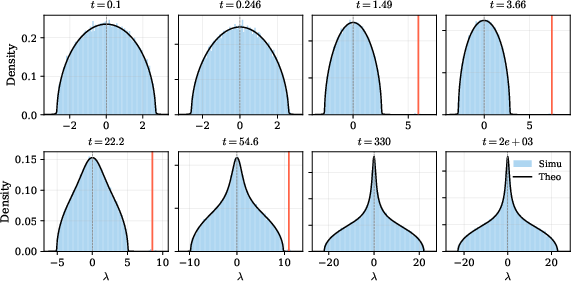
Figure 1: Empirical spectral density of α3 at various training times, demonstrating bulk evolution and emergence/reabsorption of the outlier as predicted by the α4 Dyson equation.
Transient BBP Transition and Outlier Analysis
The teacher-induced perturbation yields a nontrivial (rank-two) outlier equation, reducible to a quadratic condition involving block-resolvent overlaps. The BBP transition exhibits three distinct regimes:
- Weak-signal regime: No outlier ever appears; the teacher is not spectrally detectable.
- Strong-signal regime: Outlier emerges and persists after a critical time; teacher is always detectable post-transition.
- Early-stopping regime: Outlier exists only within a finite early-stopping window; only transiently detectable.
The boundaries of these regimes are dictated by the critical signal threshold α5, whose temporal profile depends strongly on input anisotropy. Anisotropic scenarios (α6) yield non-monotonic α7, supporting transient “in-and-out” spikes; isotropic cases (α8) admit only monotonic transitions.
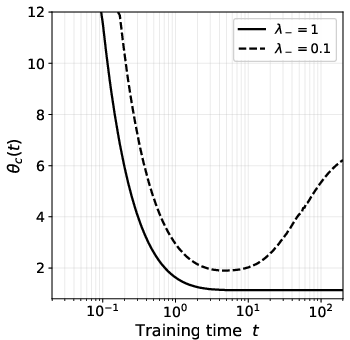
Figure 2: Evolution of α9 for different values of λ+=10, indicating the onset and disappearance of outlier regimes and their dependence on covariance anisotropy.
Phase Diagrams and Anisotropy Dependence
Phase diagrams in the λ+=11 and λ+=12 planes precisely delineate the regimes where early stopping is optimal. The “early-stopping wedge” only exists for sufficiently anisotropic data; near-isotropic inputs suppress the transient regime. Signal strength must exceed a minimum for any outlier to emerge, regardless of early stopping strategy.
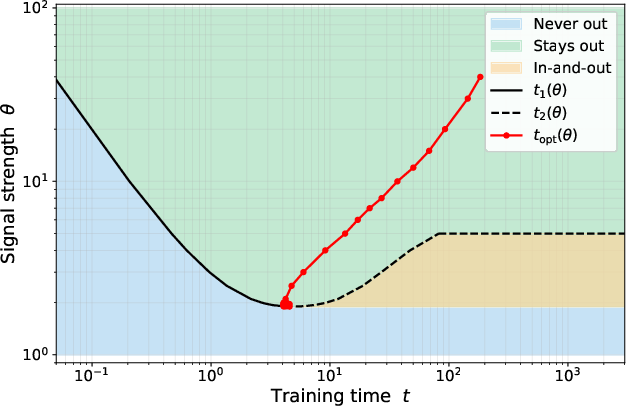
Figure 3: Phase diagram in the λ+=13 plane, with λ+=14 demarcating regions of underfitting, transient outlier existence, and persistent signal recovery; optimal stopping time traced by the red curve.
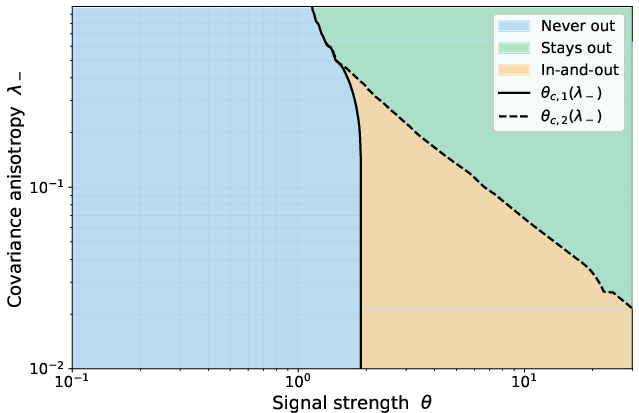
Figure 4: Outlier-regime classification in λ+=15 space, highlighting the early-stopping region (yellow) that widens with increased anisotropy.
Teacher Recovery, Overlap, and Early-Stopping Criterion
The squared overlap λ+=16 (where λ+=17 is the leading eigenvector) assesses teacher recovery. In the early-stopping regime, this overlap peaks within the transient window, defining a theoretically motivated optimal stopping time λ+=18. As the outlier merges with the bulk, λ+=19 falls to baseline, marking the onset of overfitting.
Numerical simulations confirm the overlap’s unimodal behavior and its dependence on signal and covariance structure. Results using continuous power-law covariance spectra corroborate the robustness of the transient BBP mechanism beyond the two-block model.
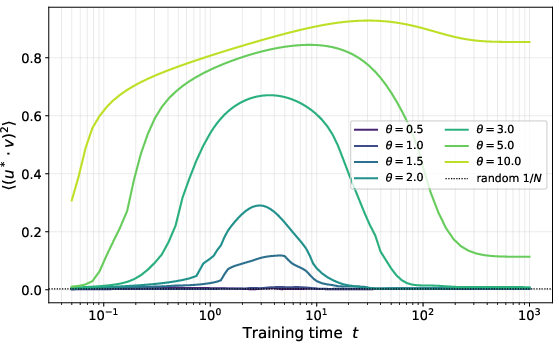
Figure 5: Temporal evolution of teacher-direction overlap 1−α0 for various signal strengths, illustrating the three learning regimes and the necessity of early stopping in the transient phase.
Implications and Future Directions
The formalism unambiguously links early stopping to transient spectral effects governed by input covariance anisotropy. It provides a minimal, analytically tractable mechanism for early stopping as a necessity, not a heuristic, when the signal is hidden by spectral noise at late training times. Practically, this underscores the importance of monitoring spectral outliers as proxies for signal detectability.
Theoretical implications extend to the general training dynamics of neural networks, especially in settings where anisotropy and heterogeneity of the data covariance are prominent. There are clear connections to the Neural Tangent Kernel (NTK) literature, where similar spectral phenomena govern convergence and generalization.
Methodologically, the approach is grounded in resolvent analysis of Wigner-type ensembles with block variance profiles, and finite-rank perturbation theory. The explicit phase diagrams and critical thresholds enable precise predictions of when (and whether) early stopping is effective.
Conclusion
This study articulates a random matrix mechanism for the transient detectability of learned signal during gradient flow, formalizing early stopping as a spectral phase phenomenon. Anisotropy in the input covariance is essential: it creates fast and slow learning directions, enabling the signal to be observable only temporarily. The BBP transition’s presence, boundaries, and optimal stopping time are precisely mapped, with numerical validation across models. The results call for further exploration of spectral regularization in overparameterized and nonlinear deep learning systems, where heavy-tailed spectra and layer interactions may compound or modulate the transient BBP geography identified herein.