- The paper introduces an integrated ecosystem combining Agents, Sims, and Assistants to address AI agents' scalability, coordination, and personalization challenges.
- The paper reviews the evolution from symbolic AI to multi-agent systems, underscoring the persistent issues of brittleness and limited generalization.
- The paper proposes novel hybrid architectures, improved coordination mechanisms, and ethical guidelines to enhance real-world AI agent performance.
Agents Are Not Enough: A Detailed Examination
The paper "Agents Are Not Enough" critically explores the current status and limitations of AI agents, arguing that creating merely more capable agents is inadequate for addressing the complex tasks they are envisioned to accomplish autonomously. The authors present a comprehensive review of the historical development of AI agents, identify key challenges, and propose an innovative ecosystem comprising Agents, Sims, and Assistants to enhance their effectiveness and usability.
Historical Context and Limitations of AI Agents
AI agents have evolved through several technological eras, each marked by distinct approaches and challenges:
- Early AI Agents: Grounded in symbolic reasoning, these agents, exemplified by the General Problem Solver (GPS), were limited by their dependence on predefined rules and inability to handle real-world complexity.
- Expert Systems: While successful in narrow domains, systems like MYCIN and DENDRAL were brittle, unable to generalize due to extensive manual knowledge engineering.
- Reactive Agents: The subsumption architecture pioneered by Rodney Brooks demonstrated real-time interaction capabilities but lacked planning and learning from experiences.
- Multi-Agent Systems (MAS): Promising distributed problem-solving approaches faced significant challenges in coordination and scalability.
- Cognitive Architectures: Despite sophisticated designs like SOAR and ACT-R, these architectures struggled with real-time performance and practical applications.
Key limitations identified include a lack of generalization, scalability issues, coordination challenges, brittleness, and significant ethical and safety concerns. These shortcomings highlight the need for a broader approach to developing AI agents capable of handling complex tasks effectively.
Proposed Ecosystem: Agents, Sims, and Assistants
The authors propose shifting focus from solely enhancing agent capabilities to establishing an integrated ecosystem with three core components:
- Agents: Specialized, autonomous modules designed for specific tasks. Improvements such as integrating machine learning and symbolic AI, adopting new architectures, and enhancing coordination and robustness are essential.
- Sims: Representations of user preferences and behaviors that can act on behalf of users, incorporating privacy and personalization. Sims bridge the gap between agents and users by contextualizing tasks based on individual user needs.
- Assistants: Personal programs that interact directly with users, possessing a comprehensive understanding of their preferences. These entities coordinate with Sims and Agents to perform tasks and ensure seamless user-agent interaction.
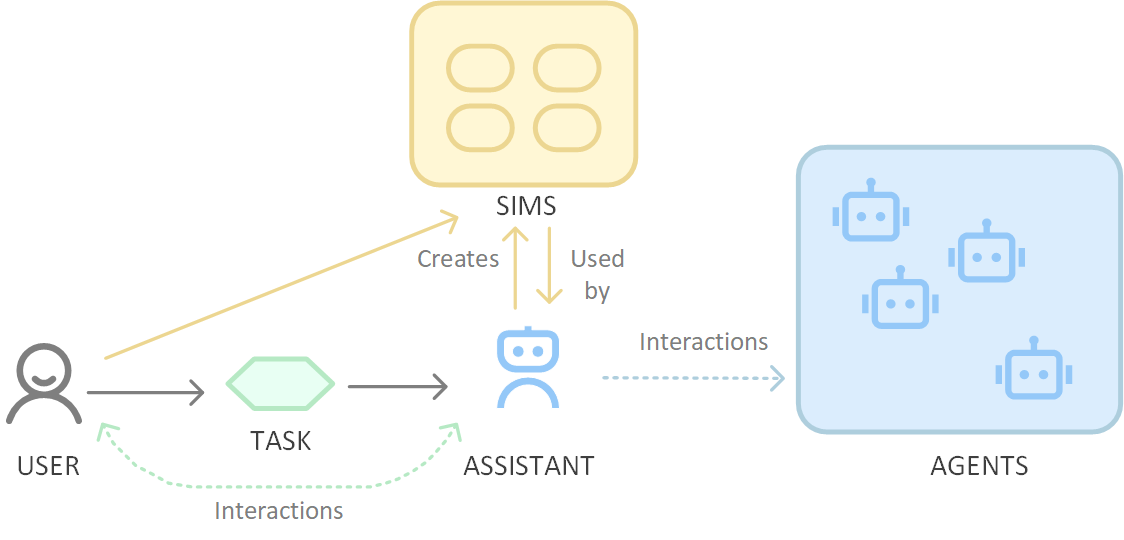
Figure 1: Envisioning a new ecosystem with Agents, Sims, and Assistants.
Overcoming Challenges with AI Agents
To address the longstanding issues with AI agents, several strategic directions are proposed:
- Integration of Machine Learning and Symbolic AI: Enhancing adaptability through hybrid approaches that leverage learning from data as well as structured reasoning.
- Novel Architectural Approaches: Implementing hybrid models with efficient caching to manage complexity and scalability, enabling better task decomposition and specialization.
- Advanced Coordination Mechanisms: Developing protocols that improve multi-agent interaction and negotiation, enhancing overall system performance.
- Robust Learning Algorithms: Utilizing reinforcement and transfer learning to foster adaptability and cross-task learning.
- Ethical and Responsible Design: Prioritizing transparency, fairness, and accountability through guidelines and frameworks to address ethical considerations effectively.
Practical Implications and Future Directions
The establishment of an integrated ecosystem with Agents, Sims, and Assistants has profound practical implications for AI deployment:
- Value Generation and Personalization: Ensuring agents generate genuine value for users through adaptable and personalized interactions that respect privacy and trust.
- Social Acceptability and Standardization: Achieving mainstream adoption requires societal acceptance and standardized protocols to ensure safety, security, and interoperability across various agents.
- Trustworthiness and Ethical Deployment: Building user trust through robust testing, transparency, and gradual capability enhancement will be critical as AI agents assume more significant roles in decision-making and personal assistance.
Conclusion
The paper underscores that advancing AI agents' capabilities alone is insufficient for their effective deployment in complex real-world scenarios. An ecosystem approach that incorporates Agents, Sims, and Assistants represents a comprehensive strategy to address current limitations while fostering trust, personalization, and user-centric service delivery. Future developments in AI agent systems will likely focus on refining these interactions and structures to maximize their impact and integration into everyday life.