- The paper reveals that the free option in ePBS allows builders to avoid losses, leading to potential empty blocks during volatile market conditions.
- The study uses theoretical models and empirical validation, showing that up to 6% of blocks may be affected when market volatility spikes.
- Mitigation strategies such as shortening the option window and imposing penalties are proposed to balance scalability gains with network liveness.
The Free Option Problem of ePBS
Introduction
The paper "The Free Option Problem of ePBS" (2509.24849) addresses a crucial issue arising from Ethereum's upcoming Glamsterdam upgrade, which introduces enshrined Proposer–Builder Separation (ePBS). While ePBS aims to enhance the blockchain by improving trust and scalability, it inadvertently creates a new liveness risk. Builders gain a "free" option to prevent an execution payload they have committed to from becoming canonical, thereby potentially rendering a block empty without incurring additional penalties. This paper systematically studies the implications of this free option problem using theoretical models and empirical analysis.
Free Option Dynamics
Under ePBS, builders are granted a brief period to reveal the full payload and blobs after committing to the block header, eliminating the need for trusted relays. This approach improves Ethereum's throughput but also provides builders with a window of opportunity to decide against making a block canonical by withholding blobs.
The free option problem manifests when builders exercise this option in response to adverse market conditions, such as unfavorable ETH price movements, to avoid losses. This action results in an empty block, degrading network liveness and user experience. The paper finds that while the option is rarely profitable to exercise on average, it becomes significant during volatile periods.
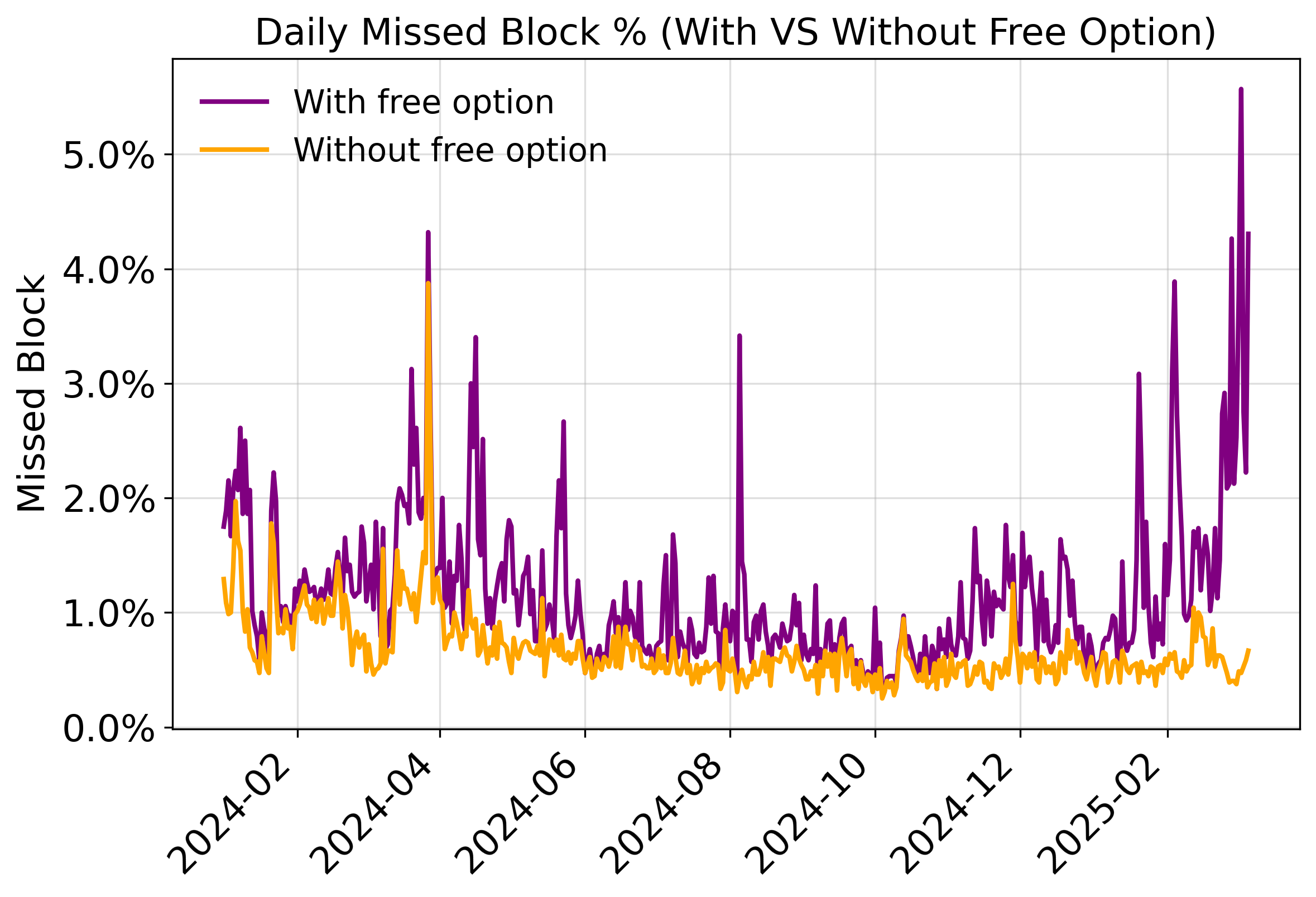
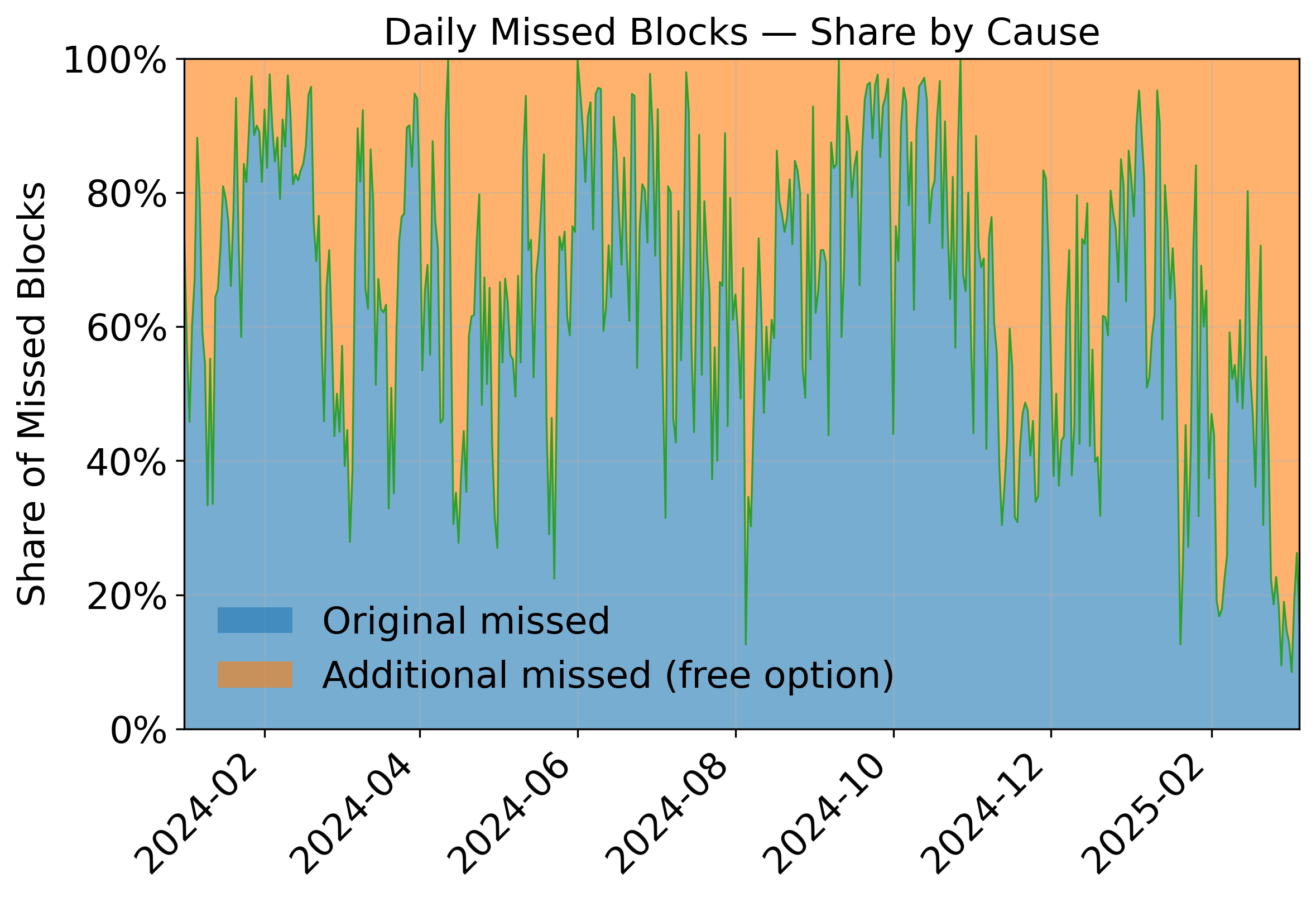
Figure 1: Daily missed block percentage with and without the ePBS free option and share of daily missed blocks by original causes and by the ePBS free option.
Theoretical Predictions and Empirical Validation
The paper's theoretical framework predicts that the option value and exercise probability increase with market volatility, the length of the option window, and the block's dependency on external market signals. Empirical analyses of historical Ethereum blocks confirm these predictions: the average exercise probability is low but spikes during periods of high volatility. Specifically, up to 6% of blocks are affected on such days.
Furthermore, builders dependent on CEX-DEX arbitrage are more likely to exercise the option, highlighting the economic incentives that drive this behavior. The paper demonstrates that shortening the option window or penalizing exercised options can mitigate these risks effectively.
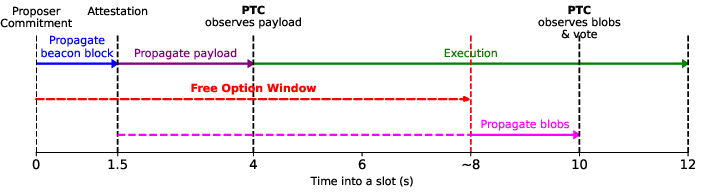
Figure 2: Slot pipeline and PTC deadlines under ePBS. Red markers indicate the free option window, which extends until the latest point when a strategic builder can release blobs while still ensuring the payload remains valid.
Mitigation Strategies
Two primary mitigation strategies emerge from the research:
- Shortening the Option Window: By reducing the time builders have to decide, the liveness risk is minimized. However, this comes at the expense of the increased blob propagation time that aids in scaling Ethereum's throughput.
- Imposing Penalties: Introducing penalties makes exercising the option costly, rather than free, thereby discouraging its use. This strategy requires careful calibration to avoid inhibiting builder participation due to increased costs.
In addition to these, the paper also explores dynamic penalties that adapt to historical exercise rates, providing a balance between cost and effectiveness.
Conclusion
The study provides a comprehensive analysis of the free option problem, highlighting the delicate balance between the benefits and risks introduced by ePBS. While Ethereum aims to improve blockchain performance and scalability with ePBS, it must also contend with the new risks to network liveness posed by the strategic incentives granted to builders. The proposed mitigation strategies, while effective, necessitate trade-offs that must be carefully managed to preserve the integrity and efficiency of the network. Looking forward, addressing these challenges will be key to optimizing Ethereum's protocol and maintaining a fair, decentralized network.